
The Lee County Inmate Population
The Lee County inmate population is the group of people held in the county jail system at any given time. That system is operated by the Lee County Sheriff's Office Corrections Bureau, not by a city police department. It has three parts: the Downtown Jail in Fort Myers, the larger Core Facility on Ortiz Avenue, and the smaller Community Program Unit at the same Ortiz address. The Downtown Jail is the central intake and booking point for everyone arrested anywhere in the county, so a person booked by Fort Myers or Cape Coral police still enters the same Sheriff-run population.
Most people counted in the jail are pre-trial detainees, which means they are waiting for court and have not been convicted. Others are serving short county sentences, and a smaller number are held for federal authorities under an agreement with the U.S. Marshals Service. The count rises and falls with arrests, bond decisions, sentencing, and transfers. When someone is sentenced to state prison, custody shifts to the Florida Department of Corrections, and that person leaves the county count. The Sheriff's Corrections Bureau is the agency that reports the official local figures used on this page.
Lee County Inmate Population Statistics
The clearest local numbers come from the Lee County Sheriff's Office Corrections Bureau, which publishes annual operating figures and the rated bed capacity of each facility. The Sheriff lists a 2024 average daily inmate population of 1,606 people. The three facilities hold a combined 2,009 listed beds, and the Bureau reported more than 18,000 bookings during the year. Every figure below is tied to its official source and year, and any metric the Sheriff does not publish is left off rather than estimated.
The Corrections Bureau page is the best single record of the county's jail scale, covering bookings, releases, meals, transport, and medical spending. The screenshot below shows where these official figures are published.
The Lee County Sheriff posts its facility list and 2024 operations statistics on the LCSO Corrections Bureau page.
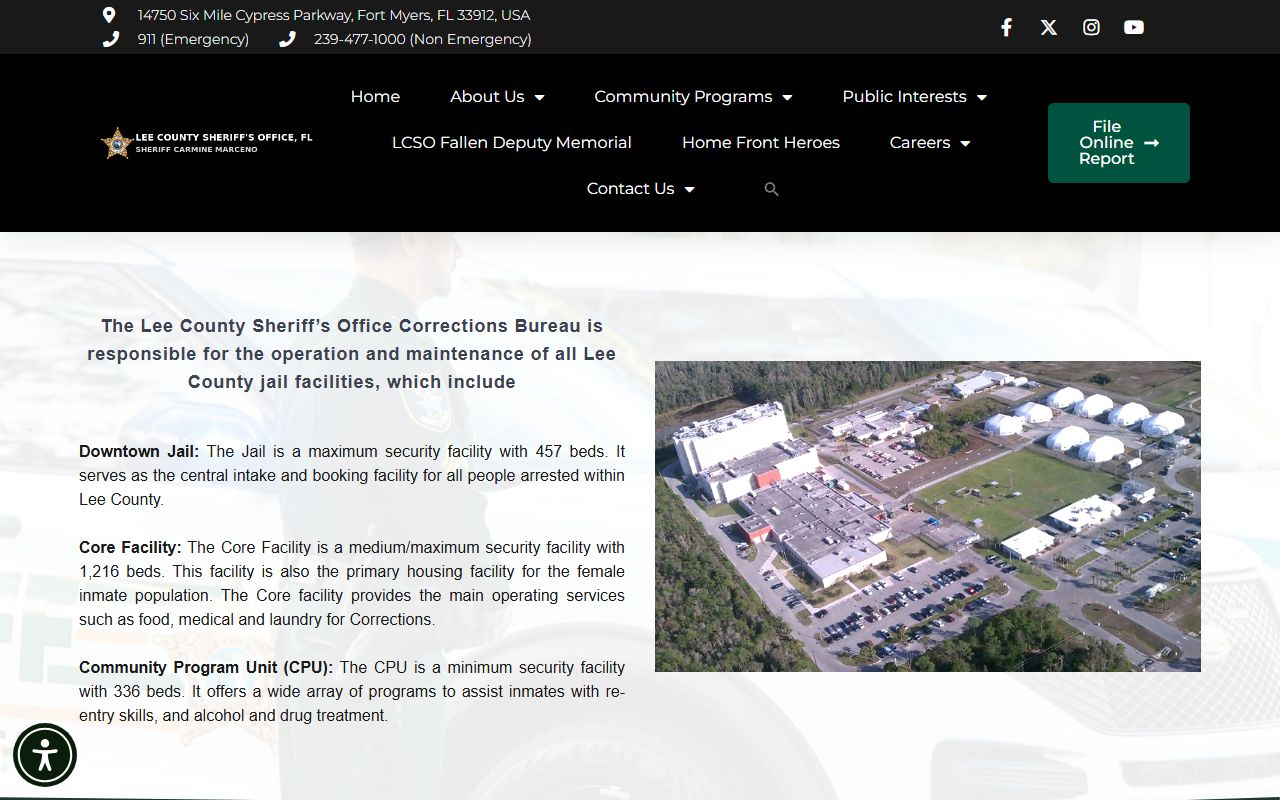
That same page is where the average daily population, booking totals, and per-facility bed counts on this site are drawn from, which keeps the Lee County inmate population figures traceable to the Sheriff.
| Measure | Figure | Source / Year |
|---|---|---|
| Average daily population | 1,606 | LCSO Corrections Bureau, 2024 |
| Prior-year average daily population | 1,523 | LCSO Corrections Bureau, 2023 |
| Total listed bed capacity | 2,009 | LCSO Corrections Bureau, 2026 |
| Admissions booked | 18,032+ | LCSO Corrections Bureau, 2024 |
| Admissions released | 17,973 | LCSO Corrections Bureau, 2024 |
| Inmate meals served | 1,549,425+ | LCSO Corrections Bureau, 2024 |
Note: The 2,009-bed figure is the sum of the three listed facility capacities, not a separate total-capacity number published by the Sheriff.
Lee County Inmate Population Trends
The most reliable trend the official source supports is the year-over-year change between 2023 and 2024. The Lee County inmate population rose from an average of 1,523 to 1,606, an increase of 83 people, or about 5 percent. Booking and release totals stayed close to each other in 2024, with more than 18,000 admissions and just under 18,000 releases, which fits a population that grew slowly rather than spiking.
| Year | Average Daily Population | Notes |
|---|---|---|
| 2023 | 1,523 | Prior-year average cited by the Corrections Bureau |
| 2024 | 1,606 | Up 83 over 2023, about a 5 percent rise |
A longer three-to-five year trend is not published in the official Sheriff source reviewed for this page, and no daily dashboard or current-count tool was found. Because of that, the two-year change is the only sourced trend shown here. A complete daily figure would need a public-records request or a direct call to the Corrections Bureau.
Who Makes Up the Lee County Inmate Population
Florida law expects counties to track the jail population by category, and the makeup of the Lee County inmate population breaks down along facility, custody, and program lines. The Sheriff describes the split mainly by security level and by which facility houses which group, rather than by a published race or age table.
- Pre-trial and sentenced - The jail holds people waiting for court alongside those serving short county sentences; pre-trial detainees are the larger share.
- Female housing - The Core Facility is the primary housing facility for the female inmate population.
- Program and minimum custody - The Community Program Unit holds lower-risk inmates in re-entry, alcohol, and drug treatment programming.
- Federal holds - A U.S. Marshals agreement lets the jail house federal detainees, including people awaiting immigration hearings.
Some terms come up often when reading about who is held in the county jail. A short glossary helps before the lookup sections below.
- Pre-trial detainee
- A person held while a case is pending, who has not been convicted.
- PR bond
- Personal recognizance release, where the court frees a person without upfront bond money, usually with conditions.
- Detainer
- A hold placed by another agency, such as the U.S. Marshals or ICE, that can keep a person in custody even after local bond is posted.
- Classification
- The jail's review of risk and needs that decides custody level and housing.
- DOC
- The Florida Department of Corrections, which holds sentenced state prisoners, not county jail detainees.
Lee County Jail Capacity and Overcrowding
The three Sheriff-listed facilities hold 2,009 beds in total: 457 at the Downtown Jail, 1,216 at the Core Facility, and 336 at the Community Program Unit. Set against the 2024 average daily population of 1,606, the county ran at roughly 80 percent of its listed beds on an annual-average basis. That simple comparison does not prove there were empty beds in every unit, because crowding shifts with classification, sex, medical needs, segregation rules, and federal holds.
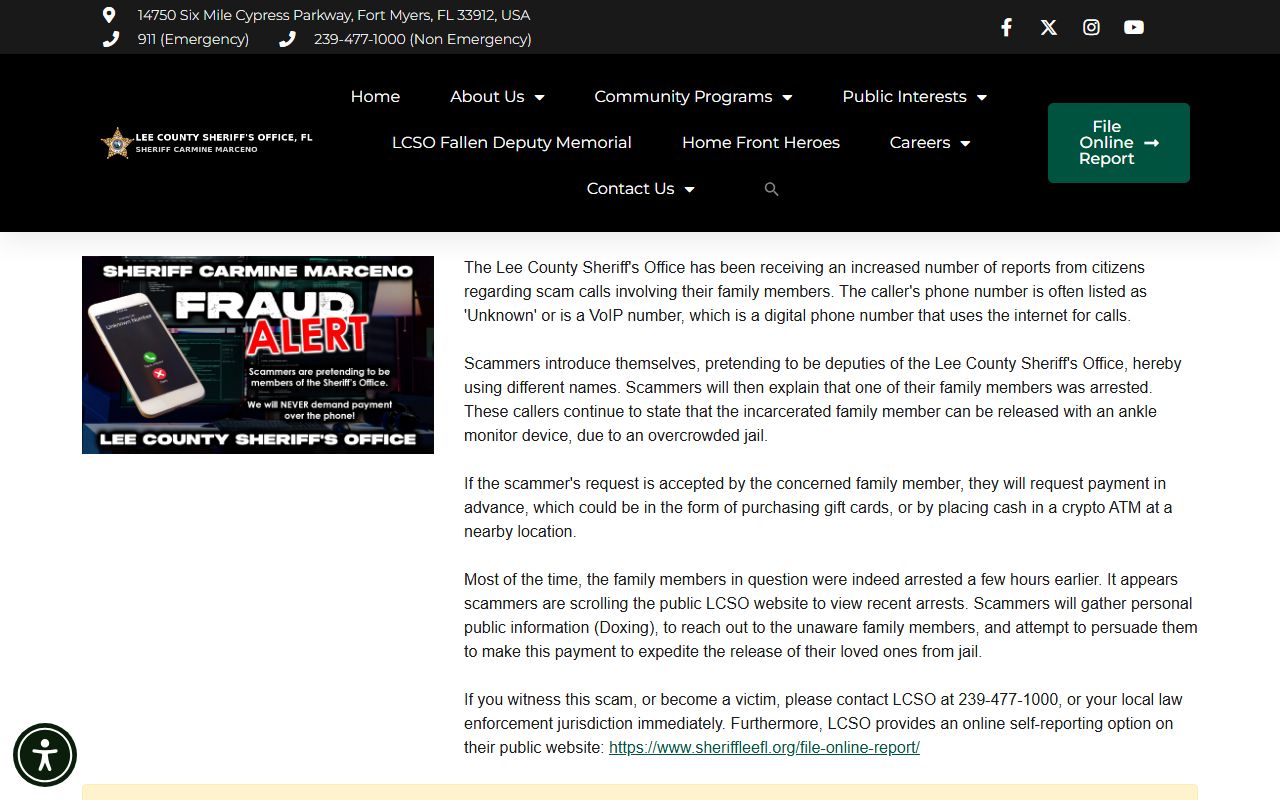
No official consent decree, overcrowding lawsuit, or new-jail construction project was documented in the Sheriff sources reviewed for this page. The county did publish a fraud warning noting that scammers falsely claim a relative will be released because the jail is overcrowded, but that is a description of a scam, not an official finding about capacity. The honest read is a population that sits below total listed capacity while still leaving real pressure inside specific housing units.
Scam alert: The Sheriff warns that callers posing as deputies use recent arrest data to demand payment for a relative's release or ankle monitor; verify any such call through official LCSO channels before paying anyone.
Laws Governing the Lee County Inmate Population
Several Florida laws make jail population and booking data public and set the standards the county jail must meet. The Public Records Act treats most jail records as open to inspection, a separate chapter defines county detention facilities and requires monthly population reporting to the state, and a statewide standards code governs how the jail operates and is inspected. Together these rules are why the Lee County inmate population is searchable at all and why the Sheriff must track who is held and report it.
Key Statutes:
Florida Statutes Chapter 119 - The Public Records Act makes most jail, booking, and inmate records public unless a specific exemption applies.
Florida Statutes Chapter 951 - Defines county detention facilities and requires jail administrators to report monthly population categories to the state and to follow minimum jail standards.
Florida Model Jail Standards - Set the minimum rules for jail construction, sanitation, food, medical care, classification, and twice-yearly inspections.
Florida Statutes § 119.07 - Requires custodians to allow inspection and copying of public records and to redact only the exempt parts.
Note: Chapter 951 requires counties to report categories such as felony and misdemeanor pre-trial detainees and sentenced inmates, even when those breakdowns are not posted on a public webpage.
Lee County and the State Prison Population
Not everyone arrested in Lee County stays in the county count. A person convicted of a felony and sentenced to state prison moves into the custody of the Florida Department of Corrections after sentencing and classification. At that point the Lee County jail roster may no longer show the person, and the statewide FDC offender locator becomes the right tool. No state prison sits physically inside Lee County, so the county's link to the state prison population is through sentencing and transfer rather than a local prison building.
This is one of the most common points of confusion for families. Someone who disappears from the Sheriff's roster has often been sentenced and transferred, not released. Checking the FDC locator before assuming a release saves a lot of worry.
How to Search the Lee County Inmate Population
The official tool for the Lee County inmate search is the Sheriff's Arrest Search, posted on the LCSO website. The Sheriff labels it "Arrest Search," but most people think of it as the jail roster, the inmate search, or the recent-bookings page. It covers people booked into the county jail system, including current inmates and recent releases. Before starting, a last name is enough; a booking number narrows it fastest.
The screenshot below shows the Sheriff's search form and the fields it accepts.
The county roster lives on the official LCSO Arrest Search page.
Using the fields shown there, the steps below walk through a standard Lee County inmate search from a name to a full booking profile.
- Open the LCSO Arrest Search page and choose Recent Bookings for the newest activity or the name fields for a known person.
- Enter the inmate's last name, and add a first name when the last name is common.
- Add a date of birth to separate people who share a name, or type a booking number for an exact match.
- Set In Custody to Yes for someone currently held, or No or All when checking a recent release.
- Open the booking-number link to view the mugshot, housing, charges, bond, case number, and arresting agency.
- If you need the final court outcome, move from the Sheriff's roster to the Lee Clerk court search.
Current Inmate Lookup in Lee County
A current Lee County inmate lookup runs through the same Arrest Search form, with In Custody set to Yes. The roster pulls live data from the Sheriff's official booking system, so a newly booked person can appear with a housing value such as "JAIL - INTAKE" while processing is still underway. The Sheriff does not publish an exact refresh schedule, so this site does not claim a real-time or fixed-minute update window. The search-field table below lists what the form accepts.
| Field Label | Type | Required | Notes |
|---|---|---|---|
| Last Name | Text | No | Most common starting point; pairs well with a date of birth. |
| First Name | Text | No | Narrows a common last name. |
| Date Of Birth | Date | No | MM/DD/YYYY; separates people who share a name. |
| Booking # | Text | No | Numeric booking number; the narrowest identifier. |
| In Custody | Dropdown | No | All, Yes, or No; choose Yes for current custody. |
| Booking Date Range | Date range | No | Checks activity during a short window. |
Past and Released Inmate Records
Finding someone who is no longer in custody works a little differently. The Recent Releases button and the release-date range surface people who have left the jail, and setting In Custody to No or All can reveal records that a current-only search would miss. The Sheriff does not publish how long a released booking stays visible on the roster, so older records may not appear online at all.
When the roster does not go back far enough, the official fallback is a public-records request through the Sheriff's GovQA portal, which is the right channel for an archived booking record, an official booking sheet, or a record not shown on the search screen. The Sheriff treats the online roster as a courtesy, not a substitute for a formal records request under Chapter 119.
What a Lee County Inmate Record Shows
A Lee County booking profile carries far more than a name. The Sheriff's public booking data includes identity details, a mugshot when one exists, current housing, and a separate charge record with bond and court fields. The table below describes the main fields a search returns.
| Field | What It Shows |
|---|---|
| Booking Number | The unique number for that arrest and booking event. |
| Booking Date | The date and time the person was booked into the jail. |
| Charges | The arrest charges, each with a statute code, count, and plain description. |
| Bond Amount | The bond per charge, which can read as a dollar figure, Not Set, or No Bond. |
| Housing Unit | The current jail location, such as an intake status while processing. |
| Custody Status | Whether the person is in custody or released, with a release date when it applies. |
The arrest charges shown here are not final court outcomes. The Sheriff directs anyone who needs the disposition of a case to the Lee County Clerk, and booking photos for current inmates appear on the Lee County jail mugshots page.
County Jail vs. State Prison: Where to Look
Knowing which system holds a person decides which search to run. Pre-trial detainees and short-sentence inmates sit in the Lee County jail and show on the Sheriff's roster. Sentenced felons move to a Florida Department of Corrections prison and show in the statewide locator instead. The comparison below sorts out which tool covers which part of the population.
| County Jail | State Prison (DOC) | |
|---|---|---|
| Who Is Held | Pre-trial and short sentences | Sentenced felons |
| Run By | Lee County Sheriff's Office | Florida Department of Corrections |
| Where to Look | LCSO Arrest Search roster | FDC offender locator |
| Stays Listed | While in custody and recently released | Through the sentence and supervision |
Important: A sentenced inmate often vanishes from the county roster after transfer to state prison. That is a move into FDC custody, not a release, so check the state locator before assuming someone is free.
State and Federal Inmate Search
Beyond the county roster, three more locators cover different slices of the population. The Florida Department of Corrections inmate search covers people sentenced to state prison or supervision. The federal Bureau of Prisons locator covers federal inmates from 1982 forward, though it may not show every pretrial detainee held under the U.S. Marshals agreement. The ICE Online Detainee Locator covers people in immigration custody, but it excludes anyone under 18. For custody alerts, VINELink Florida sends notifications when a status changes.
Each tool answers a different question. Using the county roster for a sentenced state prisoner, or the federal locator for a county arrest, is the most common reason a search comes up empty.
Lee County Detention Facilities
The Lee County inmate population is spread across three Sheriff-run facilities, each holding a different group. The Downtown Jail handles booking and the highest custody level, the Core Facility carries most of the housing and the female population, and the Community Program Unit runs lower-security programs. Each facility has its own page with addresses, visitation, and lookup detail.
- Lee County Downtown Jail - Maximum-security central intake and booking for everyone arrested in the county.
- Lee County Core Facility - The largest unit, primary female housing, plus food, medical, and laundry operations.
- Lee County Community Program Unit - A minimum-security unit for re-entry, alcohol, and drug treatment programs.
Lee County Inmate Population FAQ
How big is the Lee County inmate population?
The Lee County Sheriff's Office Corrections Bureau reported a 2024 average daily inmate population of 1,606, up from 1,523 in 2023. The three jail facilities hold a combined 2,009 listed beds, so the annual-average population ran near 80 percent of total listed capacity.
How do I search the Lee County inmate population?
Use the Sheriff's Arrest Search on the LCSO website. Enter a last name, add a first name or date of birth to narrow common names, or type a booking number for an exact match. Open the booking link to see charges, bond, housing, and custody status.
Can I look up a released or past inmate?
Yes, up to a point. The Recent Releases button and the release-date range show recent departures, and setting In Custody to No or All can surface them. The Sheriff does not publish how long released records stay online, so older bookings may require a public-records request through the GovQA portal.
Is the county jail roster the same as the state prison locator?
No. The Lee County roster covers pre-trial and short-sentence inmates held by the Sheriff. Once a person is sentenced to state prison, custody moves to the Florida Department of Corrections, and the statewide FDC locator is the correct search.
Why can't I find someone who I know was arrested?
The name may be spelled differently, the booking may be too new to appear, or the person was arrested outside the county. They may also have been transferred to state, federal, or immigration custody, each of which uses a separate locator.
Are the charges on the roster the final charges?
No. Roster charges are arrest charges. The State Attorney reviews each arrest and decides what to file, so the formal charges can differ. Final case outcomes live in the Lee County Clerk's court records, not on the Sheriff's roster.