
Lee County Court Records After a Jail Arrest
After an arrest in Lee County, the booking begins at the Sheriff's jail and the charges recorded there are arrest charges. The court record starts later, when the State Attorney for the 20th Judicial Circuit reviews the arrest and files a formal charging document. That filing opens a case in the Lee County Clerk's system, and from that point the case docket, not the jail roster, is the authoritative record of the charges, hearings, and outcome.
It helps to separate the two sides. The booking and custody side, including who is in jail and on what arrest charges, lives on the Sheriff's roster covered in jail inmate records, and the booking photo appears on the jail mugshots page. The court record after an arrest is the prosecutor's filed charges and everything the court does with them. A jail booking can even show a case number before the court file is easy to find, which is the practical bridge between the arrest and the court record.
How to Find Lee County Court Records After an Arrest
The court record after an arrest is searched through the Lee County Clerk's MATRIX Court Records Inquiry. MATRIX is the public case-search portal, and it is where the charges the prosecutor filed, the hearings, and the dispositions appear. The arrest and booking detail stays on the jail roster, while the charge record lives in the court file.
- Open the Lee Clerk MATRIX portal at the Clerk's court-records site.
- Search by case number when the jail booking showed one, or by the defendant's first and last name.
- Select the matching criminal case type, such as Adult Felony, Misdemeanor, or Criminal Traffic.
- Open the case to read the filed charges, each charge's code and level, and its current status.
For statewide criminal-history context beyond a single county case, a person can also check court resources for other circuits, but the Lee County court record after a local arrest starts in MATRIX. The Clerk also offers Florida Courts e-Notify for court-date alerts, which is a notification tool rather than a case database.
MATRIX Court Search Fields and Limits
MATRIX accepts several search fields and applies real limits that shape what comes back. A case number is the most precise route, while a name search supports wildcards, including a star in the first-name box to search by last name only. The table lists the main fields.
| Field Label | Type | Required | Notes |
|---|---|---|---|
| Case Types | Checkbox group | No | Adult Felony, Misdemeanor, Criminal Traffic, ordinances, and more. |
| First Name | Text | No | Use a star to search by last name only. |
| Last Name | Text | No | Supports a trailing star for partial names. |
| Case Number | Text | No | Exact case number narrows results fastest. |
| Citation Number | Text | No | Useful for traffic and criminal-traffic matters. |
| Date From / Date To | Date | No | MM/DD/YYYY range to narrow common names. |
Case searches return only the first 500 results and hearing searches the first 200, so a broad name search can miss records. General-public access is incomplete for Mental Health, Probate, Guardianship, Juvenile, and Domestic Relations cases, and business-name searches require free registration. Many records for cases opened before 2004 are available only through the Clerk's records-request system.
Key Statute:
Florida Statutes § 119.0714 - Governs confidentiality and redaction in court records, including Social Security and account numbers and other protected information, which is why some details are hidden online.
How Charges Get Filed After an Arrest: Complaint, Information, and Indictment
The court record after an arrest does not exist until a charging document is filed. Booking happens at the jail, then the charge record begins when the prosecutor or a grand jury files one of three documents. The type depends on how serious the offense is and how the case is brought.
| Complaint | Information | Indictment | |
|---|---|---|---|
| Filed By | Officer / Prosecutor | State Attorney | Grand Jury |
| Common For | Misdemeanors | Most felonies | The most serious felonies |
| Starts | The case | The case | The case |
In Florida, most felony cases proceed by information filed by the State Attorney, while the most serious charges can go before a grand jury for an indictment. Whichever document is filed, it is the act that turns an arrest into a court record with a case number.
Charge Status and What It Means
Charges change as a case moves, and the booking charges on the jail roster can differ from what the prosecutor finally files. A charge can be amended, reduced, added, dropped, or dismissed. Reading the status terms in the court record keeps an arrest charge from being mistaken for a conviction.
| Status | What It Means |
|---|---|
| Pending | The charge is filed and the case is still moving through the court. |
| Amended / Reduced | The prosecutor changed the charge, often to a lesser offense. |
| Dismissed | The charge was dropped and the court will not pursue it. |
| Nolle Prosequi | The prosecutor formally chose not to pursue the charge. |
Note: A dismissed or nolle prosequi charge can still leave an arrest record in place unless the person seals or expunges it through a separate court process.
The State Attorney's Role After an Arrest
The office that decides the charges is the State Attorney for the 20th Judicial Circuit, led by State Attorney Amira D. Fox. The circuit covers Lee County along with Charlotte, Collier, Glades, and Hendry counties. The office reviews each arrest for legal sufficiency, then files the formal charges it can support with law and evidence. Those charges may match the arrest charges, or they may be different.
The official 20th Judicial Circuit State Attorney site explains the office's role in prosecuting cases for the State of Florida.
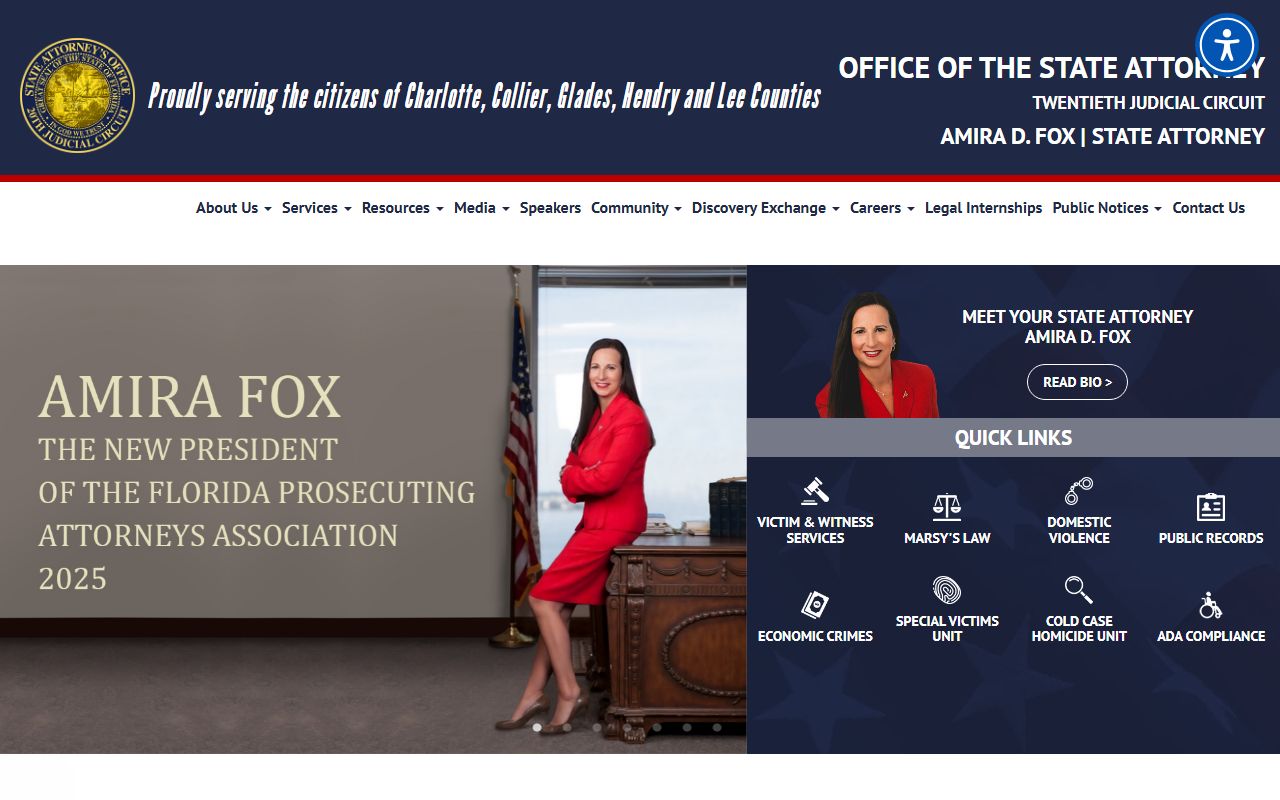
Because the prosecutor, not the arresting officer, sets the final charges, the court record is where the real charges show up. The State Attorney does not run the jail and does not maintain the court docket; the Sheriff books the arrest and the Clerk keeps the case file.
Bond and Release After an Arrest
Bond is set as a case begins, often at a first appearance, and it decides whether a person can be released while the court record moves forward. Florida uses several bond types, and a hold from another agency can keep someone in custody even when a local bond is posted. The table outlines the common types.
| Bond Type | How It Works |
|---|---|
| Cash Bond | Money is posted for release when the court allows it. |
| Surety Bond | A licensed bail agent posts the bond for a fee or collateral. |
| PR / Own Recognizance | The court releases the person without upfront money, with conditions. |
| No-Bond Hold | The person cannot bond out on that charge or hold without court action. |
The Sheriff did not publish detailed bond posting hours or payment methods, so this page does not list accepted payment types. The jail charge record can show whether bond is set or "No Bond," but a federal detainer, an immigration hold, or a warrant from another county can still prevent release.
Warrants That Lead to an Arrest
An outstanding warrant is a common path into the jail and, from there, into a court record. An arrest warrant or a bench warrant can lead to a booking, after which the arrest charges, bond, and any case number show on the Sheriff's roster. The Sheriff also keeps a Wanted Fugitives page, though it is a highlighted list rather than a complete warrant database.
The Sheriff posts featured wanted persons and tip instructions on the LCSO Wanted Fugitives page.
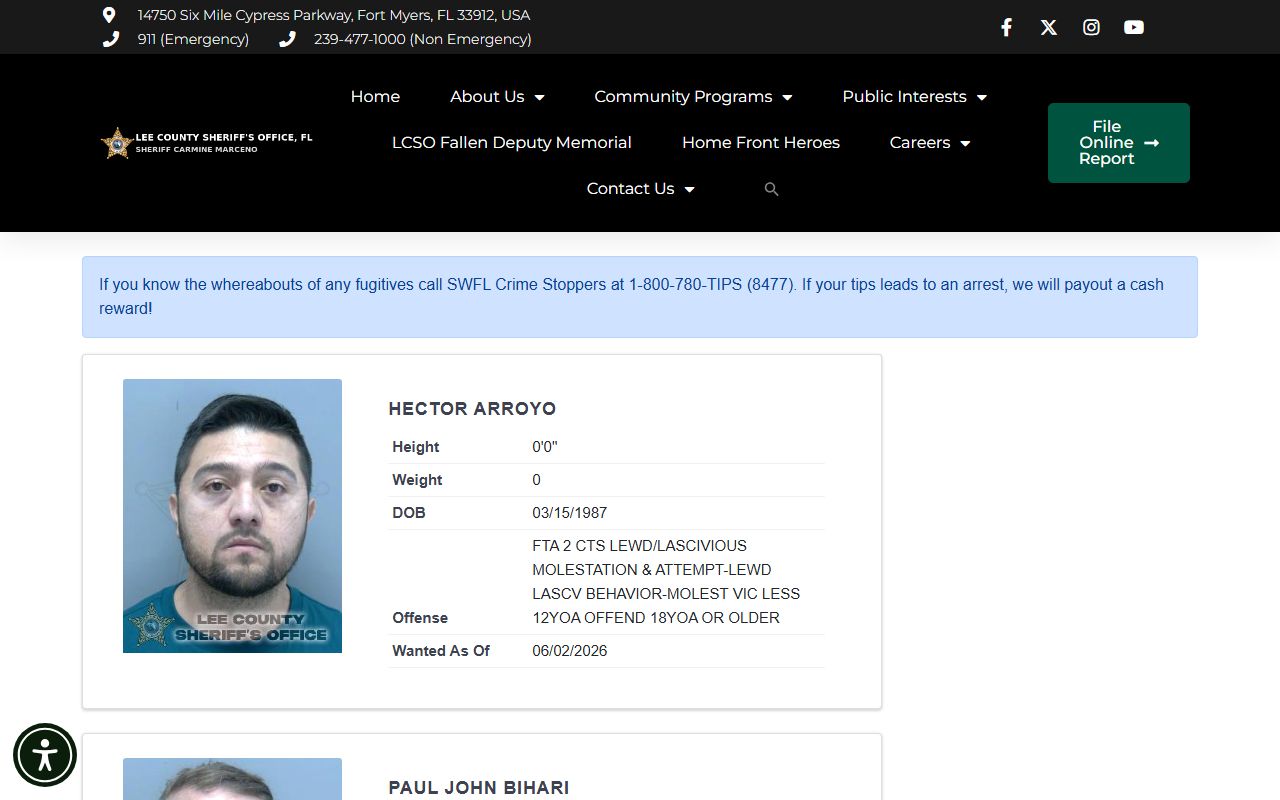
Anyone who knows a fugitive's whereabouts is asked to call Southwest Florida Crime Stoppers at 1-800-780-TIPS. A person who believes they have a warrant should verify it through the court or law enforcement and consider legal counsel, because appearing at the jail can result in arrest. No statewide Florida public warrant search was documented in the official sources reviewed here.
Charges vs. Convictions
Being arrested and charged is not the same as being convicted. A charge is an accusation that opens the court record; a conviction is the result of a plea or a verdict. The court file can show charges that never end in a conviction.
| Charge | Conviction | |
|---|---|---|
| Stage | Accusation | Verdict or plea |
| Burden of Proof | Probable cause | Beyond reasonable doubt |
| Public Record | Yes | Yes |
Sealed vs. Expunged Arrest Records
After a dismissal or an eligible disposition, a person may be able to clear an arrest record through the court. Florida treats sealing and expunging differently, and eligibility depends on the charge and the outcome. The court, not this site or the Sheriff, decides these requests.
| Sealed | Expunged | |
|---|---|---|
| Visibility | Hidden from public view | Destroyed or treated as if it never existed |
| Law Enforcement | Limited access remains | Very limited access |
| Eligibility | Depends on charge and disposition under Florida law | Often after a dismissal or no-conviction outcome |
Clearing a court record through sealing or expungement is separate from removing a booking photo from a commercial website. The court process changes the official record; it does not control private sites.
Restricted Court Records After an Arrest in Lee County
Not every court record after an arrest is fully public. Juvenile cases, sealed charges, and certain case types carry limited public access, and active investigative information can be withheld under the public-records exemptions. MATRIX itself returns incomplete results for several sensitive categories, and the Access Security Matrix governs which documents a general-public user can open online.
For older or restricted records, the Clerk's records-request path is the fallback, especially for cases before 2004. Expect redactions for Social Security and account numbers, confidential informant identity, and material a court has sealed.
Important: This site is not a consumer reporting agency under the FCRA, and court-record information here may not be used for employment, tenant, credit, or insurance screening.