
Lee County Jail Mugshots Overview
The Lee County Sheriff's Office displays booking photos on its public Arrest Search when an image exists for the record. The roster pulls from the agency's own booking system, and the result table shows a booking photo thumbnail alongside the name, date of birth, booking number, and custody status. Opening the full booking page can display the photo with the rest of the person's public booking fields.
Not every record carries a visible photo. The Sheriff does not publish a recent-bookings mugshot gallery as a separate showcase, and it does not state how long a photo stays public after release. The agency frames the roster as a courtesy and reminds users that arrest data reflects the circumstances at the time of booking, not a final court outcome. A booking photo on the roster, then, is a public record of an arrest, not a verdict.
Behind the scenes, the booking image is delivered as photo data within the Sheriff's official booking system and rendered on the result and profile pages when it exists. That technical detail matters for one reason: the photo you see is the agency's own official booking image, not a copy scraped from somewhere else. When a record has no image, it usually means none was published for that booking, not that the person was never booked.
Where to Find Lee County Booking Photos
The booking photo lives on the same Arrest Search used for any Lee County inmate search. There is no separate mugshot site to visit, and there should not be: the official roster is the accurate source. The steps below move from a name to a booking photo, with a records request as the fallback.
- Open the Sheriff's Arrest Search page, or use Recent Bookings for the newest records.
- Search by last name, adding a date of birth or booking number to narrow the result.
- Open the booking-number profile to view the booking photo and the details published with it.
- If no photo appears, file a public-records request with the Sheriff for the booking photograph rather than assuming none exists.
The same roster covered on the jail inmate records page is where booking photos appear, so a single search answers both the custody question and the photo question.
What a Lee County Booking Photo Shows
A booking photo rarely stands alone. The Sheriff publishes it next to the demographic and booking fields captured at intake, so the photo is one part of a larger record. The inventory below highlights the photo field and the data shown with it.
| Field | What It Shows |
|---|---|
| Booking Photo | A single booking image taken at intake, shown when an image exists; no multiple angles are documented. |
| Name | Surname, given name, and middle name, with a permanent ID number. |
| Demographics | Date of birth, birth country, race, sex, height, weight, and hair. |
| Booking Date | The date and time the booking was recorded. |
| Charges | The arrest charges with statute codes and plain descriptions. |
The roster can also expose an address field, which is sensitive even though it is public. The photo and these fields answer who was booked and when, not how the case ended.
The charge data sits in a separate part of the record from the photo and identity fields. A booking can show one or more charges, each with its own statute code, count, and bond status, and a case number may appear once the court system assigns one. None of that changes what the photo itself is: a single image captured at intake. The Sheriff documents only one booking image per record, with no multiple angles and no published history of prior booking photos, so a profile shows the current booking rather than a gallery of past arrests.
Are Lee County Jail Mugshots Public Record?
In Florida, booking photos are generally public records under the state's Public Records Act, subject to specific exemptions. The Sheriff must allow inspection and copying of nonexempt records and redact only the exempt parts. A separate law targets commercial websites that publish booking photos and charge people to take them down. Each statute does a different job.
Key Statutes:
Florida Statutes § 119.07 - Requires custodians to allow inspection and copying of public records and to redact only the exempt portions.
Florida Statutes § 119.071 - Exempts certain law-enforcement information, such as active criminal investigative material and confidential informant identity.
Florida Statutes § 901.43 - Bars commercial booking-photo publishers from charging for removal and requires takedown within 10 days of a proper request.
The commercial-publisher law does not mean the Sheriff must delete every official booking photo on request. It targets private sites that profit from removal, which is a separate issue from the official roster and from sealing a court record.
How Long a Mugshot Stays on the Roster
The Sheriff did not publish how long a booking photo stays visible after a person is released, or whether prior booking photos remain in the public roster over time. Because of that, this page does not claim a 24-hour, 48-hour, or custody-only rule. The honest answer is that the official source does not state a fixed retention window.
What is and isn't public: The roster shows the booking photo and public booking fields when an image exists, but it can withhold exempt law-enforcement material, and it does not promise that every booking has a photo. For a photo not shown online, the official route is a records request, not a commercial site.
How to Request a Lee County Booking Photo
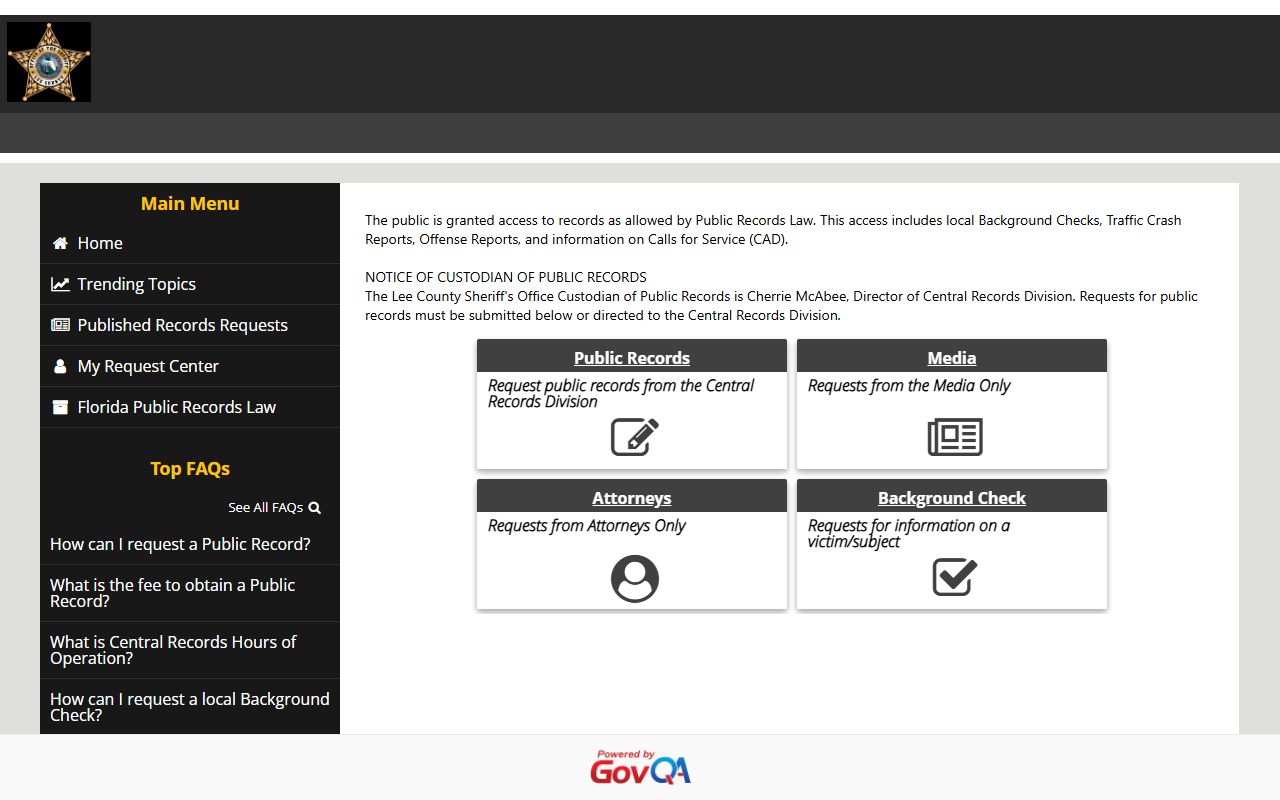
When a booking photo is not visible online, the official fallback is a public-records request through the Sheriff's GovQA portal, run by the Central Records Division. The portal accepts public-records, media, attorney, and background-check requests, and it is the right channel for an official booking photo, booking sheet, or offense report.
The Sheriff's public records portal shows the request categories and custodian information.
A clear request includes the person's name, date of birth if known, the booking number or approximate arrest date, and exactly what you want, such as the booking photograph. Florida sets copy-fee limits, including up to 15 cents per one-sided page, with a certified-copy fee of up to one dollar; the Sheriff did not publish a separate fee table for booking photos.
Mugshot Removal and Sealed Records
Removing a booking photo is not one single action. The commercial-publisher law addresses private sites that charge to take a photo down, while clearing an official record runs through the court. If a case was dismissed or is otherwise eligible, the way to limit a public arrest record is to seal or expunge it, which is covered under sealing and expunging an arrest record.
This site does not name, link, or endorse any commercial mugshot-publishing or pay-to-remove service. The Sheriff's own roster links users to the Lee County Clerk for how an arrest record can be removed from the official website, so the records-clearing route runs through the court, not a paid removal site. A photo that is no longer visible online does not mean a case was dismissed or a record expunged; those are separate questions, decided by different offices and on different timelines. Confusing the two is one of the most common mistakes people make when they search for a Lee County booking photo.
Booking Photos and Arrest-Related Scams
Public booking photos and arrest data have a downside that is worth knowing before you search. The Lee County Sheriff has warned that scammers scroll the public roster, pull recent arrest details, and call families to demand payment for a relative's release, sometimes claiming the jail is overcrowded or that an ankle monitor fee is due. The booking photo and the arrest record are real public data, which is exactly what makes the scam convincing.
The defense is simple. No legitimate agency collects release payments by phone from a family member who saw a booking online. If you get a call like that, hang up and verify directly through the Sheriff's official non-emergency line before paying anyone. The same caution applies to commercial websites that copy booking photos and then charge to remove them; the lawful way to limit a public arrest record runs through the court, not a paid takedown service.
Note: Treat a booking photo as a record of an arrest at a moment in time, not as proof of guilt, and be careful about juvenile records, which carry added confidentiality protections under Florida law.
Federal and State Booking Photos
Federal custody works differently from the county roster. The federal Bureau of Prisons locator confirms custody but does not function as a public mugshot gallery, and the U.S. Marshals do not publish booking photos through it. Searching the federal locator for a mugshot will not return one.
At the state level, the Florida Department of Corrections inmate locator can show a photo for a sentenced prisoner, but that image serves a corrections purpose and is separate from a county jail booking photo. So a person's photo may appear in the county roster during a case and later in the state locator after a prison sentence, with no public federal equivalent in between.